 FDA Thailand

Incomplete labels and raw-material documents are the main reason factories and the Thai FDA send files back for correction. This guide summarises the Thai FDA label requirements for packaged food, when a nutrition label or a Guideline Daily Amounts (GDA) label is required, what a dietary supplement label must add, and how a specification, a Certificate of Analysis, a Technical Data Sheet and a Safety Data Sheet differ. It is written for foreign brands and exporters preparing products for Thailand, and for Thai teams who work in English.
Thai FDA label requirements for food: Notification No. 450
Every food sold in a package in Thailand must show a basic set of items. They are set by Ministry of Public Health Notification No. 450 B.E. 2567 (2024) on labelling of food in packages. B.E. means Buddhist Era, the Thai calendar, which is 543 years ahead of A.D. If a food also has its own labelling notification, the label must follow both that notification and No. 450 (Ministry of Public Health, 2024).
| Label item | Key points |
|---|---|
| Name of the food | Clause 5(1) |
| Food serial number | Clause 5(2) |
| Name and address of the manufacturer, repacker or importer | Clause 5(3). A word must show which role the company has. Imported food must also show the manufacturer's name and country |
| Net quantity in metric units | Clause 5(4). Solids show net weight; liquids show net volume |
| Main ingredients | Clause 5(5). As approximate percentages by weight, with exceptions such as labels with a total area under 35 square centimetres |
| Allergen information | Clause 5(6). When an allergen is an ingredient or may be present through cross-contact |
| Best-before or expiry date | Clause 5(9). Food that keeps for 90 days or less shows day, month and year. Food that keeps longer than 90 days may show month and year |
| Statements listed in the annex | Clause 5(13). For example, food with a desiccant sachet or with certain ingredients |
If the label shows a trademark, the brand name must be marked with the Thai word for brand or trademark, under clause 13 of the same notification. An English word or symbol may be used instead. This point is often missed, because cosmetic labels have no such rule.
The printed expiry date must not be earlier than the date the product goes on sale. If the date is printed away from its label wording, the label must say where to find it.
Allergen labelling: the 10 food groups to declare
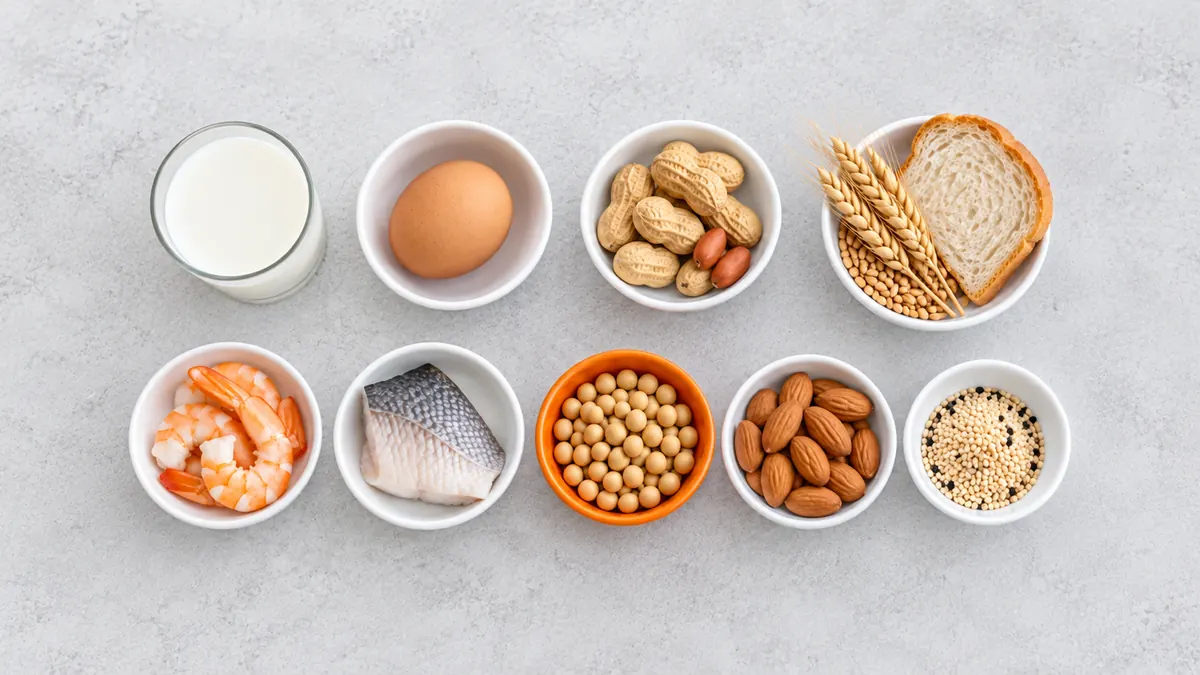
Clause 5(6) of Notification No. 450 requires the heading "allergen information" followed by "contains" when the allergen is an ingredient, or "may contain" when there is a risk of cross-contact during production, and then the type of allergenic food. If this heading is not used, the "contains" or "may contain" statement must appear in a box that is clear and easy to read. On the Thai label, these statements are written in Thai.
Ten groups of food must be declared:
- Cereals containing gluten, such as wheat, rye, barley and oats, and their products, with some exceptions such as wheat-based maltodextrin
- Crustaceans, such as crab, shrimp and mantis shrimp, and their products
- Eggs and egg products
- Fish and fish products, with exceptions such as fish gelatine used as a carrier for vitamins
- Peanuts and peanut products
- Soybeans and soy products, with exceptions such as fully refined soybean oil
- Milk and milk products, including lactose
- Tree nuts, such as almonds, walnuts and pecans
- Sulphites at 10 milligrams per kilogram or more
- Molluscs, squid and their products
This statement is not required if the food name already makes the allergen clear, such as roasted peanuts or fresh cow's milk.
Mandatory statements when a product meets certain conditions
Beyond the basic items, some foods must carry extra statements when they meet certain conditions. The examples below come from the annex to Notification No. 450 and from related specific notifications. The wording on the label must be in Thai; the right-hand column gives the meaning in English.
| If the product has this feature | The label must carry |
|---|---|
| A desiccant or oxygen absorber sachet in the pack | The word "contains" followed by the type of sachet, for example "contains desiccant sachet", in red letters at least 3 millimetres high on a white background (for food sold directly to consumers) |
| Aspartame | A statement that people with phenylketonuria should note the product contains phenylalanine |
| Ginkgo leaves or ginkgo leaf extract | Statements that it may slow blood clotting, and that children and pregnant women should not consume it |
| Ready-to-eat jelly or jelly sweets | "Children should consume only small amounts", in red letters not smaller than 5 millimetres, in a box with a white background |
| A wish to say gluten free | Only the Thai term for gluten free or "gluten free" may be used, and gluten in the final product must not exceed 20 milligrams per kilogram |
| A wish to show the healthier choice symbol | The product must be checked and certified first before the symbol can appear on the label |
These are examples, not the full list. The annex to Notification No. 450 sets warnings for other ingredients too. Before printing the final label, check every ingredient against the annex again.
Use the exact wording in the notification. Do not rephrase a warning, because different wording may be treated as not shown.
Nutrition labels: a core part of Thailand food labelling requirements
 AI-generated image
A nutrition label is the panel that shows the energy and nutrients in a food. The current format follows Ministry of Public Health Notification No. 445 B.E. 2566 (2023) on nutrition labelling, which was amended in 2025 (Ministry of Public Health, 2023a).
A food may need a nutrition label for several reasons. The most common are that it belongs to a group the notification names, such as snack foods or beverages in sealed containers, or that the label makes a nutrition claim. One product can meet several conditions at once. Notification No. 445 also sets other cases, so check the notification itself.
Percentages on the label are calculated against reference values called the Thai Recommended Daily Intakes (Thai RDIs), in Schedule 3 of Notification No. 445. These values are used to calculate the label percentages. They are not maximum amounts a product may contain.
In summary, a nutrition label is prepared like this:
- Check whether the product must show a nutrition label, based on its food group and the statements you plan to use.
- Set one serving size and the number of servings per pack.
- Get nutrient values backed by evidence, such as laboratory test reports.
- Lay out the panel following Schedule 1 of Notification No. 445.
- Check that the numbers in the panel agree with any claims on the label.
If you want a nutrition label example, the Thai FDA publishes sample nutrition panel formats under Notification No. 445 on its website. They are useful as a template to compare against.
The No. 445 format has no short-form panel. According to Thai FDA questions and answers, food that received its serial number before 2 July 2024 may keep the old panel format during a transition period, and may be sold until 1 July 2027 at the latest.
GDA labels: which foods need them and what they show
A GDA label shows energy, sugar, fat and sodium on the front of the pack, so consumers can see at once how much the whole pack contains. The foods that must show it are set in Ministry of Public Health Notification No. 394 (B.E. 2561, 2018) and its amendments (Ministry of Public Health, 2018).
Foods that must show both a nutrition label and a GDA label fall into 13 groups. The main ones are:
- Snack foods, such as potato chips, crackers, roasted or fried nuts and seasoned seaweed
- Chocolate and chocolate-flavoured sweets
- Bakery products, such as crackers, biscuits, cookies, cakes and pies
- Semi-instant foods with a seasoning sachet, such as noodles and rice porridge
- Single-dish main meals that must be kept chilled or frozen throughout sale
- Beverages in sealed containers
- Ready-to-drink tea and coffee, both liquid and dry
- Flavoured milk, fermented milk and milk products
- Soy milk
- Ready-to-eat ice cream
The current GDA format is set in the annex to Ministry of Public Health Notification No. 466 B.E. 2568 (2025) (Ministry of Public Health, 2025). Its main points:
- Four vertical cylinders, in the order energy, sugar, fat and sodium
- A white background inside the cylinders, shown on the front of the label
- Values per whole pack
- Percentages against 2,000 kilocalories of energy, 65 grams of sugar, 65 grams of fat and 2,000 milligrams of sodium
- If one pack is meant for more than one eating occasion, a statement that it should be divided into a stated number of portions
Snack foods, chocolate and bakery products must also carry a statement advising consumers to eat only a little and to exercise for health, in bold, clearly visible letters.
Some exceptions apply, for example certain beverages in returnable glass bottles, or small packs with a front label area under 65 square centimetres, which have their own display rules. Check the conditions carefully before deciding not to show a GDA label.
Claims like high, low and free have numeric criteria
Nutrition claims such as low fat, high protein or source of a vitamin have numeric criteria in Schedule 4 of Notification No. 445. You may use these words only when the food actually meets the criteria. Some examples from Table 1 of the schedule:
| Claim | Criterion per reference serving and per serving shown on the label |
|---|---|
| Energy free | Less than 5 kilocalories |
| Low energy | Not more than 40 kilocalories |
| Fat free | Total fat less than 0.5 grams |
| Low fat | Total fat not more than 3 grams |
| High in protein or dietary fibre | 20 percent of Thai RDIs or more |
| Source of protein or dietary fibre | 10 percent of Thai RDIs or more |
| High in a vitamin or mineral | 30 percent of Thai RDIs or more |
| Reduced fat or reduced energy | Reduced by 25 percent or more compared with a reference food |
Some foods use criteria per 100 grams of food or per 100 kilocalories instead, under Table 2. For many claims, "free" or "low" cannot be used if the food is naturally that way. When you make a claim, total fat, saturated fat and sodium must be shown next to it, in letters at least half the size of the claim.
Claims that an ingredient has a function in the body are health claims. They are covered by Ministry of Public Health Notification No. 447 B.E. 2566 (2023), which has a list of permitted statements. A statement outside the list needs an assessment submitted case by case (Ministry of Public Health, 2023b).
Dietary supplement labels: what Thai FDA rules add
Dietary supplement labels must follow the notification on dietary supplements, as amended by Ministry of Public Health Notification No. 405 B.E. 2562 (2019) (Ministry of Public Health, 2019). They must also include the basic items in Notification No. 450. The extra items are:
- The Thai term for dietary supplement must be part of the product name, or appear with the name.
- Net contents: tablets or capsules show the number of units, liquids show net volume, solids show net weight.
- The names and amounts of key ingredients and of ingredients with claimed benefits, from highest to lowest.
Every dietary supplement must carry this set of warnings, using the exact Thai wording in the notification. In English, they mean:
- The word "Warning", in letters at least 1.5 millimetres high, inside a box, with letter colour contrasting with the box and box colour contrasting with the label
- Children and pregnant women should not take this product.
- Eat a variety of foods from all 5 food groups in the right proportions regularly.
- Has no effect in preventing or treating disease, in bold letters inside a box.
Some ingredients need extra warnings, such as ginkgo leaves or aspartame. Check both the lists in the dietary supplement notifications and the annex to Notification No. 450. A warning that is word-for-word the same in both may be shown once.
The label must also agree with the product specification. The Thai FDA manual for dietary supplement applications, 2026 edition, sets minimum items, such as lead not more than 1 milligram per kilogram, total arsenic not more than 2 milligrams per kilogram, and Salmonella not detected in 25 grams (Thai FDA, 2026). The amounts of key ingredients printed on the label should be backed by test results.
Words or images that suggest treating disease contradict the mandatory warning on the same label. This is a common reason for correction orders.
Beyond the label: Spec, COA, TDS and SDS
When a factory receives a raw material, or an officer asks for more information, four documents are requested most often. Each answers a different question.
| Document | What it answers | Common mistakes |
|---|---|---|
| Specification (Spec) | Which values the material or product must have, and in what range | No test method stated, or limits that do not match the grade being sold |
| Certificate of Analysis (COA) | What the delivered lot actually measured, and whether it meets the specification | No lot number, or only the word pass with no numeric results |
| Technical Data Sheet (TDS) | Appearance, use, dosage and storage | Information that conflicts with the specification, such as colour, form or production method |
| Safety Data Sheet (SDS) | Hazards, handling, first aid and safe storage | Missing sections, or text copied from another product |
The Safety Data Sheet was formerly called the Material Safety Data Sheet (MSDS). The common structure has 16 sections under the Globally Harmonized System of Classification and Labelling of Chemicals (GHS). This is an international standard, not a Thai FDA notification.
In practice, these problems are often found in raw-material document sets:
- Documents disagree on appearance, extraction method or grade, for example one says cosmetic grade and another says food grade.
- The substance name and its Chemical Abstracts Service (CAS) number do not match.
- Buddhist Era and A.D. years are mixed, so a document looks as if it expired before it was made.
- The ingredient percentages add up to more than 100 percent.
- The key compound content in the Certificate of Analysis does not say whether it is on a dry or wet weight basis.
Many document errors come from typing mistakes, outdated versions or criteria from another country. They do not mean the supplier meant to mislead. Ask for a corrected version.
Imported food labels and Thai cosmetic labels
Imported products whose original label is in a foreign language usually need an added Thai label, such as a sticker on the pack. An imported food label must show the importer's name and address, plus the manufacturer's name and country, under clause 5(3) of Notification No. 450.
Cosmetic labels follow a different rule: the Cosmetic Committee notification on cosmetic labels B.E. 2562 (2019), which sets 11 items.
- The cosmetic name and trade name, larger than other text
- The type or kind of cosmetic
- The names of all ingredients, from highest to lowest. Ingredients below 1 percent and colourants need not be in order, but must come after those above 1 percent
- Directions for use
- The name and address of the manufacturer or importer; for imports, also the manufacturer's name and country of manufacture
- Net quantity
- The batch number or code
- Month and year of manufacture
- Month and year of expiry, for cosmetics with a shelf life under 30 months or those listed in the annex
- Warnings, if the formula contains a substance with a required warning
- The notification receipt number
Cosmetic labels for products sold in Thailand must be in Thai, except ingredient names, which may be in English. Small containers with a label area under 20 square centimetres must show at least the name, batch, month and year of manufacture, month and year of expiry (where required) and the notification receipt number. Other items may go on an accompanying leaflet (Cosmetic Committee, 2019).
Talk to our team about labels and regulatory documents
The team at TIBD Co., Ltd. reviews and corrects labels against Thai rules, prepares specifications, Certificates of Analysis, Technical Data Sheets and Safety Data Sheets, fixes documents returned by a factory or the Thai FDA, and assembles filing dossiers. The process starts when you send the details. The team contacts you to understand the work, then sends the scope and a quotation. The team works in Thai and English.
If you would like to do a first check yourself, RA Advisor, an assistant for Regulatory Affairs (RA) questions on this site, accepts label photos and questions typed in plain sentences. It is an artificial intelligence tool that gives initial guidance, not a Thai FDA decision. The free ingredient search shows mandatory warnings and limits for each ingredient.
You can reach us through the form on the Talk to our team page, on LINE at @tibdglobal, or by email at info@tibdglobal.com.
Frequently asked questions
What must a Thai food label show?
The basic items under Ministry of Public Health Notification No. 450 B.E. 2567 (2024): the food name, the food serial number, the name and address of the manufacturer or importer, net quantity in metric units, main ingredients as percentages, allergen information, the best-before or expiry date, and any warnings listed in the annex. If the food has its own labelling notification, follow that too.
Which foods need a nutrition label in Thailand?
Foods in groups that the notification names, such as snack foods, bakery products and beverages in sealed containers, and foods whose label makes a nutrition claim, such as low fat or high protein.
What does a Guideline Daily Amounts (GDA) label show?
A GDA label shows energy, sugar, fat and sodium per whole pack, in four cylinders on the front of the label, with percentages against 2,000 kilocalories of energy, 65 grams of sugar, 65 grams of fat and 2,000 milligrams of sodium.
Which warnings must a dietary supplement label carry in Thailand?
The word Warning in a box, followed by statements that children and pregnant women should not take the product, that people should eat a variety of foods from all 5 food groups, and that the product has no effect in preventing or treating disease. The exact Thai wording from the notification must be used. Some ingredients need extra warnings.
What is the difference between a Certificate of Analysis (COA) and a specification (Spec)?
A Spec states the range each value must fall in. A COA reports what was actually measured in a specific lot, compared with the specification. A good COA shows the lot number and numeric results, not just the word pass.
References
- Ministry of Public Health. (2024). [Notification of the Ministry of Public Health (No. 450) B.E. 2567 (2024) on labelling of food in packages] (in Thai). Open document ↗
- Ministry of Public Health. (2023a). [Notification of the Ministry of Public Health (No. 445) B.E. 2566 (2023) on nutrition labelling] (in Thai). Open document ↗
- Ministry of Public Health. (2018). [Notification of the Ministry of Public Health No. 394 (B.E. 2561) on foods required to show nutrition labelling and energy, sugar, fat and sodium values in GDA format] (in Thai). Open document ↗
- Ministry of Public Health. (2025). [Notification of the Ministry of Public Health (No. 466) B.E. 2568 (2025) on foods required to show nutrition labelling and energy, sugar, fat and sodium values in GDA format (No. 3), effective 12 December 2025] (in Thai). Open document ↗
- Ministry of Public Health. (2023b). [Notification of the Ministry of Public Health No. 447 B.E. 2566 (2023) on health claims of food on labels, effective 2 July 2024] (in Thai). Open document ↗
- Ministry of Public Health. (2019). [Notification of the Ministry of Public Health (No. 405) B.E. 2562 (2019) on dietary supplements (No. 3)] (in Thai). Open document ↗
- Thai Food and Drug Administration. (2026). [Manual for dietary supplement applications (revised edition 2026)] (in Thai). Open document ↗
- Cosmetic Committee. (2019). [Notification of the Cosmetic Committee on cosmetic labels B.E. 2562 (2019), dated 14 June 2019] (in Thai). Open document ↗