 FDA Thailand
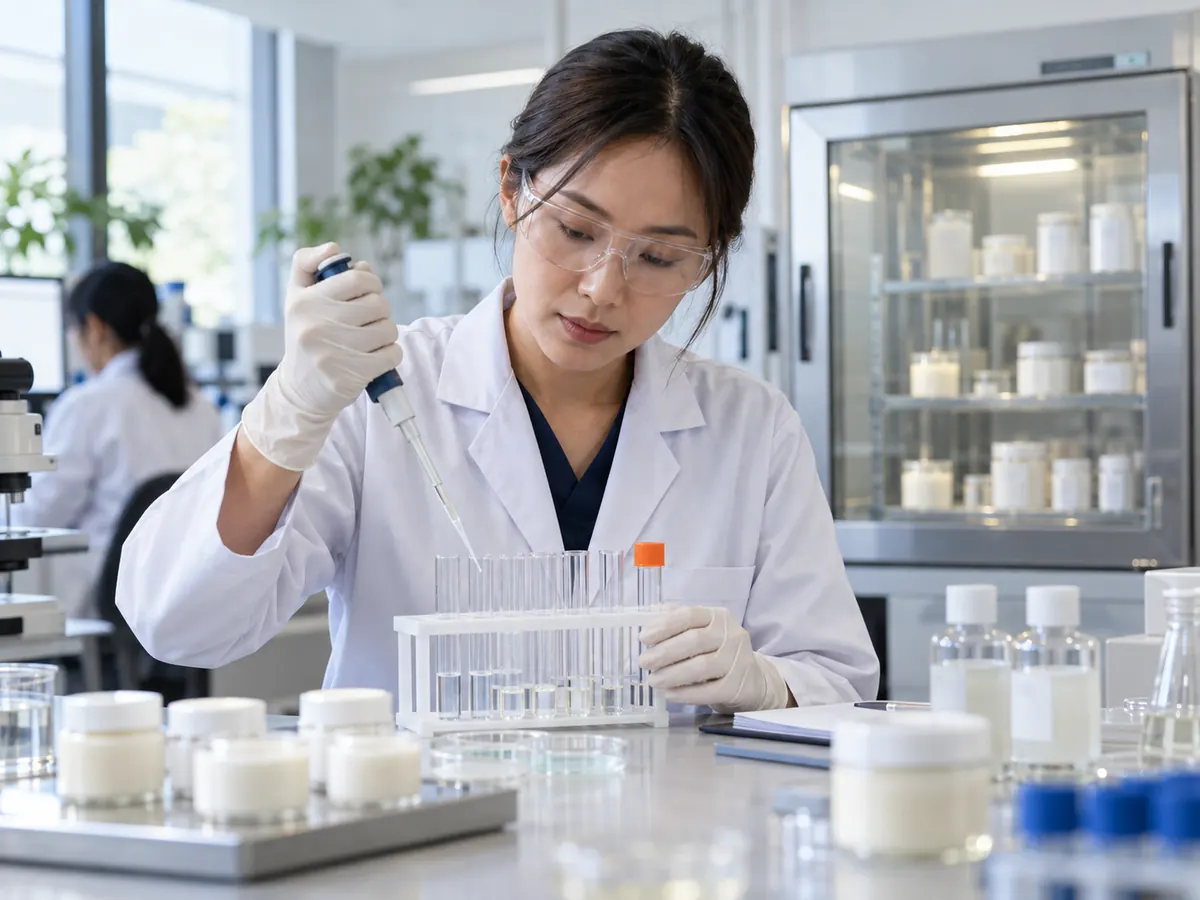
Lab results are evidence that many products need, both when filing with the Thai Food and Drug Administration (Thai FDA) and when proving claims in advertising. This guide explains stability testing for cosmetics, which Thai notifications set the limits for microbiology and heavy metal tests, what makes a lab report usable for a filing, and how to plan efficacy and patch tests, so that one round of testing gives you data you can actually use. It is written for brand owners, importers and manufacturers looking for a cosmetic testing lab or a food testing laboratory in Thailand.
Cosmetic and food testing in Thailand: what lab results are for
Many brand owners send samples to a lab only after a document is requested. This often leads to repeat testing, because the tests done do not match what is needed. Before choosing tests, be clear about how each set of results will be used. There are usually four purposes:
- Filing with the Thai FDA. For example, a dietary supplement application needs analysis results against the quality specification of the finished product (Thai FDA dietary supplement application manual, revised 2026).
- Showing that the product does not fall into a category the law bans from being produced, imported or sold, such as microbial or heavy metal contamination above the limits.
- Supporting the expiry date on the label. Cosmetic labels must show the month and year of manufacture and of expiry (Cosmetic Act B.E. 2558 (2015), Section 22).
- Proving claims on labels and in ads. The Thai FDA can order the notifier or the advertiser to prove a statement it suspects is exaggerated (Cosmetic Act B.E. 2558, Section 45).
Once the purpose is clear, you can choose the right tests, methods and number of samples. Planning from the start reduces repeat testing and the time lost waiting for documents.
A note on dates: Thai laws are dated in the Buddhist Era (B.E.), which runs 543 years ahead of the Western calendar, so B.E. 2563 is 2020. In Thailand, cosmetics are 'notified' rather than registered, and the person responsible for the product is called the notifier.
What is stability testing for cosmetics?
 AI-generated image
Stability testing tracks whether a product keeps the quality it was designed to have as time passes and under different storage conditions. Typical checkpoints are texture, color, odor, pH, viscosity, phase separation, microbiological cleanliness, and changes in the packaging.
For cosmetics, the international guidance most often cited is a technical report from the International Organization for Standardization (ISO): ISO/TR 18811:2018, guidelines on the stability testing of cosmetic products. It brings together principles and points to consider, but it does not set fixed conditions, parameters or acceptance criteria, because cosmetics come in many forms and are used in many ways. Each manufacturer therefore has to define its own test plan, with a rationale (International Organization for Standardization, 2018).
Common study designs include storage under normal conditions with real-time monitoring, accelerated storage to see degradation trends sooner, hot-cold cycling, and light exposure testing. Which ones you need depends on the product type, the packaging and the market where the product will be sold.
Results from accelerated conditions show trends, but they do not replace real data in every case. Run real-time monitoring in parallel to confirm the shelf life.
Planning a cosmetic stability study that gives usable data
A good stability plan should also answer business questions: what expiry date to set, which packaging to use, and whether the product can cope with transport or display in a hot climate. Agree on these points before the study starts:
- Use samples made with a formula and process as close as possible to real production.
- Test in the actual packaging you will sell, because the product may react with the packaging material, for example fading in color, changing in smell, or deforming the container.
- Define the parameters to monitor, and the acceptance criteria for each one, in advance.
- Set the time points for testing, and storage conditions that reflect the target market.
- Plan microbiology tests alongside, especially for water-based formulas, and consider a Preservative Efficacy Test for higher-risk formulas.
- Summarize the results in a report that supports a decision: does this formula, in this packaging, support the intended shelf life?
In practice, brands often change the packaging after the study is finished and then have to start again. Confirming the packaging before you begin can save a great deal. The duration depends on the plan you agree on, and the team will state it in the quotation.
Microbiology testing for cosmetics, food and dietary supplements
Cosmetics have clear microbial limits in the Ministry of Public Health Notification on characteristics of cosmetics prohibited from production, import or sale B.E. 2559 (2016). In summary:
| Cosmetic group | Limit |
|---|---|
| All cosmetics | No pathogens detected: Pseudomonas aeruginosa, Staphylococcus aureus, Candida albicans, and Clostridium spp. (the last one applies only to cosmetics containing herbal ingredients) |
| Products used around the eyes, on mucous membranes, or for children under 3 years | Total count of bacteria, yeast and mold (total aerobic plate count) not more than 500 colonies per gram or cubic centimeter |
| Other cosmetics | Total count of bacteria, yeast and mold not more than 1,000 colonies per gram or cubic centimeter |
The same notification requires testing by ISO methods or the latest edition of the United States Pharmacopeia (USP), or another accepted international standard method.
For food, Ministry of Public Health Notification No. 416 B.E. 2563 (2020) lists the foods it covers in Annex 1, the types and levels of pathogenic microorganisms allowed in Annex 2, and the test methods in Annex 3. This notification does not apply to dietary supplements or food additives.
Dietary supplements follow the specifications in the Thai FDA application manual. Staphylococcus aureus and Clostridium spp. must not be detected in 0.1 gram of sample, Salmonella spp. must not be detected in 25 grams, and Escherichia coli must be below 3 per 1 gram, counted by the Most Probable Number (MPN) method.
Product-specific notifications may add further tests. Before sending samples, confirm which notification your product falls under.
Heavy metal and contaminant testing: which limits apply
 AI-generated image
Heavy metal testing is one of the most common questions, because natural raw materials, minerals and herbs can pick up contamination from soil or from processing. The limits used to judge results differ by product type.
| Product type | Source of the limit | Key point |
|---|---|---|
| General food | Ministry of Public Health Notification No. 414 B.E. 2563 (2020) on food containing contaminants | Maximum levels of heavy metals and contaminants by food type in Annex 1. Foods not listed there follow the general standard for contaminants and toxins in food of the Codex Alimentarius Commission (Codex). |
| Dietary supplements | Thai FDA dietary supplement application manual, revised 2026 | Cadmium not more than 0.3, lead not more than 1, total mercury not more than 0.5 and total arsenic not more than 2 milligrams per kilogram |
| Cosmetics | Ministry of Public Health Notification on substances prohibited in cosmetics B.E. 2566 (2023) | Lead, arsenic and mercury, and their compounds, are prohibited, except as contamination in the finished product of not more than 20, 5 and 1 parts per million (ppm) by weight respectively |
Notification No. 414 also says that, for contaminants without a set limit, the producer or importer must prove that the level is acceptable. For new raw materials, or materials from unfamiliar sources, testing at the raw material stage helps reduce this risk.
The dietary supplement manual also lists other tests depending on risk, such as tin, aflatoxins, or substances from certain types of plastic packaging. The team can help you work out which ones apply to your product.
Thailand's list of substances prohibited in cosmetics is amended regularly. You can check the current status of each substance with the free Thai FDA substance search on this website.
Food testing laboratory in Thailand: which reports the Thai FDA accepts
A common question is whether any lab will do. The answer depends on how the results will be used. For internal use, such as formula development or quality control, a brand is fairly free to choose. For a Thai FDA filing, you need to check the conditions that apply to that filing.
For example, the dietary supplement application manual (revised 2026) says the Thai FDA accepts results from government agencies or agencies assigned or recognized by the government, and from laboratories accredited to an international competence standard for food testing, within the scope of the tests performed. Overseas labs can also be used if they meet these conditions. The reports must also meet other conditions:
- The report must be an original, issued no more than 1 year before the date of the application.
- Results from several labs can be combined, but they must come from the same production batch, and every report must state the batch.
- Re-analysis or additional tests must go to the same lab, unless that lab cannot perform the test.
- If the product name, brand or production site in the report does not match the application, a letter is needed confirming that the sample is the same formula.
Because of these conditions, tell the lab which filing the results are for before you send samples. The VISBIO laboratory will tell you which tests are done in VISBIO's own lab and which require coordination with a partner laboratory, so that the results fit how you plan to use them.
A supplier's Certificate of Analysis (COA) for a raw material cannot replace analysis of the finished product where the law requires the finished product to be tested.
Efficacy testing for claims before they go on a label or ad
Claims such as 'more moisturized', 'less oily' or 'cleans well' should have evidence behind them before you use them. If you cite research or statistics that cannot be proven, the Thai FDA may order the wording to be corrected or banned, or stop the ad (Cosmetic Act B.E. 2558, Section 45).
The Thai FDA has issued efficacy testing guidelines for some cosmetic groups, such as rinse-off skin cleansing cosmetics. These guidelines are for businesses that want supporting data on a voluntary basis, and they refer to international standard test methods (Thai FDA Notification on efficacy testing guidelines for rinse-off skin cleansing cosmetics, 2022).
For other claims, the principle is to design the test around the sentence you want to use, rather than testing first and looking for words afterwards. A recommended sequence:
- Write down the exact claim you want to make: the result, the target users and the period of use.
- Check first that the sentence is a claim a cosmetic may make, and that it does not suggest treating disease.
- Choose a test method that measures what the sentence says, such as instrumental measurements on volunteers' skin or laboratory tests.
- Set the number of volunteers, the inclusion criteria and the statistical analysis to fit the claim.
- Adjust the final wording to match the actual results, without stretching beyond the scope of the test.
Patch tests and human volunteer studies
A patch test checks for skin irritation or allergic reaction. The product is applied to volunteers' skin under a patch for the period set in the protocol, and trained assessors then read the skin reactions. The results support the safety assessment, and can support statements about irritation when the wording matches the scope of the test.
Every human volunteer study must protect the safety and rights of participants. Participants must be informed and must give consent, there must be inclusion and exclusion criteria, and someone must be responsible for their care if an adverse reaction occurs. Our human volunteer studies are carried out by VISBIO and partner laboratories.
Take care with how results are communicated. A good patch test result does not mean that no user will ever react. Phrases such as 'will never cause allergies' or 'completely safe' should not be used. Describe what was actually tested instead, for example that skin irritation was tested in volunteers.
Confirm the stability and microbiological cleanliness of the sample before testing it on people, for the safety of the volunteers.
Talk to our team about testing and lab work
Testing and lab services are provided by VISBIO Co., Ltd. (the VISBIO laboratory). The work covers stability testing, efficacy testing for claims and contaminant testing. Microbiology testing and human volunteer studies are carried out with partner laboratories.
To start, send your product details, the formula or ingredient list, and how you plan to use the results. The team will contact you to understand the work, then propose a test plan, a scope of work and a quotation, and start once you agree. Timing depends on the tests and the plan chosen; the team will state it in the quotation.
You can reach the team through the web form on the 'Talk to our team' page of this website, on LINE at @tibdglobal, or by email at info@tibdglobal.com. The team works in both Thai and English.
Frequently asked questions
What conditions and duration does stability testing for cosmetics need?
There are no fixed values for every product. ISO/TR 18811:2018, a technical report from the International Organization for Standardization (ISO), says each manufacturer must set its own test plan, methods, conditions and criteria with a rationale, based on the product type, the packaging, and how the product is stored and used.
What are the microbial limits for cosmetics in Thailand?
Specified pathogens must not be detected. The total count of bacteria, yeast and mold must not exceed 500 colonies per gram for products used around the eyes, on mucous membranes or for children under 3 years, and 1,000 colonies per gram for other cosmetics.
Which heavy metals must be tested in dietary supplements?
The Thai FDA dietary supplement application manual (revised 2026) sets limits for cadmium, lead, total mercury and total arsenic. Other tests may be needed depending on risk, such as tin or aflatoxins.
How long can a lab report be used for a Thai FDA filing?
For dietary supplements, the Thai FDA manual requires an original report issued no more than 1 year before the application date, and the report must state the production batch. Other types of filing may have different conditions.
If a product passes a patch test, can I say it does not cause allergies?
It is better not to. A good patch test result does not mean that no user will react. Describe what was actually tested, and avoid exaggerated statements, which Thai cosmetic law prohibits.
References
- Thai Food and Drug Administration. (2016). [Notification of the Ministry of Public Health on characteristics of cosmetics prohibited from production, import or sale B.E. 2559, dated 29 February 2016] (in Thai). Open document ↗
- Thai Food and Drug Administration. (2023). [Notification of the Ministry of Public Health on names of substances prohibited as ingredients in cosmetics B.E. 2566, dated 24 May 2023] (in Thai). Open document ↗
- Thai Food and Drug Administration. (2020). [Notification of the Ministry of Public Health No. 414 B.E. 2563 issued under the Food Act B.E. 2522 (1979) on standards for food containing contaminants] (in Thai). Open document ↗
- Thai Food and Drug Administration. (2020). [Notification of the Ministry of Public Health No. 416 B.E. 2563 issued under the Food Act B.E. 2522 (1979) on quality or standards, criteria, conditions and methods for analysis of pathogenic microorganisms in food] (in Thai). Open document ↗
- Thai Food and Drug Administration. (2026). [Dietary supplement application manual, revised 2026] (in Thai). Open document ↗
- Thai Food and Drug Administration. (2022). [Notification of the Food and Drug Administration on guidelines for efficacy testing of rinse-off skin cleansing cosmetics, dated 4 October 2022] (in Thai). Open document ↗
- Thai Food and Drug Administration. (2015). [Cosmetic Act B.E. 2558 (2015)] (in Thai). Open document ↗
- International Organization for Standardization. (2018). ISO/TR 18811:2018 Cosmetics — Guidelines on the stability testing of cosmetic products. Open document ↗